
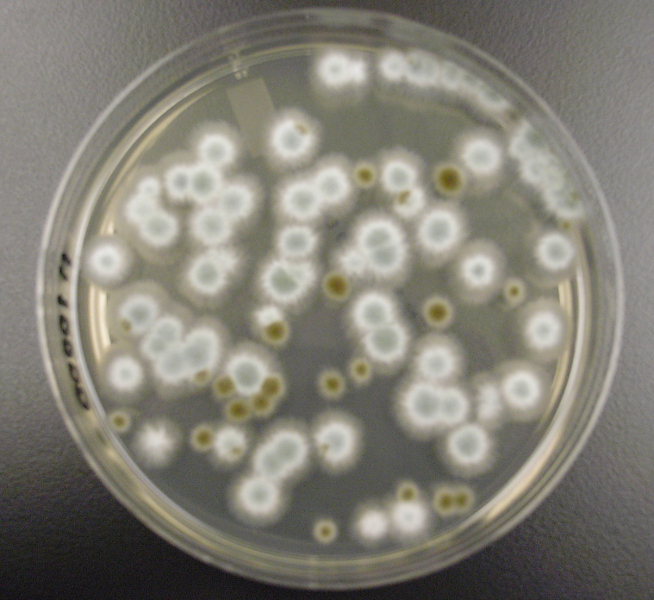
 What is white mold? Is white mold dangerous? Some molds may appear white at the early stage of their growth but change color with age (see the mold picture on the left). The reason is, with some molds the color we see is actually the color of the spores. The body of the mold (i.e., the network of filaments) is generally white or colorless. So, a mold may appear white before it produces spores and later appear black or blue after producing the colored spores. However, some molds have characteristic white color (regardless of age) since their spores are not pigmented. As with black mold, white mold is not a specific type of mold since a number of molds may appear white.
White Mold Or Efflorescence?
There are times when efflorescence is mistaken for white mold. Efflorescence is a white salt deposit commonly seen on concrete floors. As the water wicks up from the ground through the concrete it carries with it dissolved salts. When the water evaporates it leaves behind the visible white stuff which many homeowners mistake for mold. 
How To Distinguish White Mold From Efflorescence
The easiest way to distinguish white mold from efflorescence is to put some of the stuff into a drop of water. If it dissolves, it is not mold. Also, since efflorescence is crystallized salts, it breaks into a very fine powder if squeezed between fingers. If you have a question regarding white mold, please contact us at 905-290-9101.
Leave a Reply
You must be logged in to post a comment.